Can you do 12-3-30 on a walking pad?
Two of the three numbers are easy. The third one - the one that does all the work - is not published at that level by any machine on this site, and that is the honest answer.
By Stephen V. · Last updated
Not as specified. The 3 mph and the 30 minutes are within reach on every pad here. The 12 percent incline is not: only one of the eight pads we track publishes an incline in percent at all, and it publishes 6. The closest honest version is the maker’s own stated fallback of 6 to 8 percent — and on two of the three incline pads you cannot change the angle while walking anyway.
How this page is funded: the buy links here are Amazon affiliate links, and we earn a commission if you buy through one — at no extra cost to you. It does not change what we rank first, because the commission rate is the same across every machine on this page. Full disclosure.
The three numbers, and where they come from
12-3-30 is a treadmill routine: a 12 percent incline, a speed of 3 mph, held for 30 minutes. KingSmith’s own write-up of the workout records that it was created by the fitness influencer Lauren Giraldo in 2019 and spread through social media largely because the formula is three numbers and nothing else — no intervals, no speed changes, no programming.
That simplicity is why it keeps colliding with this category. Somebody buys a walking pad for a small apartment, sees a workout defined entirely by settings, and reasonably assumes a machine with an incline button can be set to those settings. The question “can you do 12-3-30 on a walking pad” is really the question “does my machine go to 12”, and that has a checkable answer.
One thing this page deliberately does not do: repeat the outcome claims that usually travel with the protocol. The article we are sourcing the parameters from also makes calorie and muscle claims, citing metabolic equations. We are not reproducing those, for the same reason our incline roundup refuses to — we are not qualified to tell you what a given grade will do for you, and a page earning a commission on the recommendation has no business implying it. What the incline specification does and does not support.
The two numbers that are easy
Take the easy half first, because it is genuinely easy.
3 mph.Every walking pad we track publishes a top speed at or above 3 mph. The published figures are 3.0 on the Lifepro PacerMini, 3.7 on the Sunny TreadPad, 3.75 on the WalkingPad P1 and A1 Pro, 3.8 on the DeerRun, 4.0 on the WalkingPad Z1 and C2, and 6.2 on the UREVO Strol 2E. So the speed is reachable on all eight — with one caveat worth naming: on the PacerMini, 3 mph isthe ceiling, so you would be running the machine flat out for the whole session and the protocol’s 2.5 to 3 mph warm-up uses the same top end.
30 minutes.Also fine, and for once there is a published figure to check it against instead of a guess. KingSmith’s FAQ states a limit of one hour at a time for a walking machine, then about half an hour off, and says the automatic stop after long use is by design rather than a fault. The protocol as described is 30 minutes plus a 5 minute flat warm-up and a 3 to 5 minute cool-down — about 40 minutes, inside that published hour with room left. The published duty cycle, quoted in full.
So two of the three numbers are not the obstacle. Which leaves the one that the whole routine is named for.
The incline, which is the whole problem
Here is the position, stated as precisely as the published record allows:
Five of the eight pads we track publish no incline figure at all. The WalkingPad Z1, C2, P1 and A1 Pro and the UREVO Strol 2E are flat machines, and in KingSmith’s case that is now confirmed by the maker rather than inferred — its FAQ names the models in its range that offer incline, and none of the four we carry is among them.
Three publish an incline, and exactly one of those publishes it in percent. The DeerRun states 6 percent, manual. That is the only figure on this entire site that can be compared directly against the protocol’s 12 percent, and it is half of it.
The other two publish degrees: the Sunny TreadPad at six automatic levels from 1.67 to 3.81 degrees, and the Lifepro PacerMini at two fixed settings of 5 and 7 degrees.
So the answer to the headline question is no, and it is a clean no rather than a hedge: there is no machine on this site whose maker publishes a 12 percent incline, and the one percent figure that exists in the category we cover is 6.
It is worth saying what this is not. It is not a claim that walking pads are bad, and it is not a claim that incline is unimportant — three makers clearly think it is worth engineering. It is a statement about what this class of machine is built to do. A pad is a deck a few inches off the floor designed to disappear under furniture; a 12 percent grade is a different machine with a different frame and a handrail.
Why we will not convert degrees to percent
The obvious move here would be to convert 5 and 7 degrees into a percentage and tell you whether the PacerMini clears 12. We are not going to, and the reason is a rule this site applies everywhere rather than a dodge on this page.
Our incline roundup states it in print: we print each figure in the unit its maker published rather than converting, because a conversion we performed would be ournumber rather than theirs, and the whole point of this site is that you can trace every figure back to the page it came from. A converted figure is an inference wearing a specification’s clothes.
What that leaves is a statement we can stand behind completely: no maker on this site publishes an incline of 12 percent or more. Nobody publishes a percent figure above 6. If your reason for buying is a protocol specified in percent, the honest thing we can tell you is that the specification you need is not published by anyone in this category, and we would rather hand you that than a conversion you cannot check.
The units being inconsistent across three products in one small category is itself worth noticing. It is the kind of thing that makes these machines hard to compare, and it is not an accident of our table — it is how the makers published them.
The part nobody mentions: changing it mid-session
Even on the pads that do have an incline, there is a second obstacle that almost nothing written about this protocol accounts for. The routine is not one setting held for 30 minutes. As described, it is three phases: about 5 minutes of flat walking at 2.5 to 3 mph to warm up, then the incline raised for the main block, then the incline dropped to 1 or 2 percent for 3 to 5 minutes to cool down.
That requires changing the angle twice, while you are on the machine.
Of the three pads here with an incline, exactly one can do that. The Sunny TreadPad has six automatic levels you change from the remote while walking. The PacerMini’s two settings are selected by swapping or flipping the feet under the deck by hand, and the DeerRun’s 6 percent is manual in the same sense — you lift the deck and set it before you start.
On a manual machine the protocol’s structure is not merely awkward, it is unavailable: you would be stepping off, unplugging, re-setting the deck and getting back on, twice, mid-session. Nobody does that. In practice a manual-incline pad gives you one angle for the whole walk, which makes it closer to “a pad with a permanent slight rise” than to an incline control.
There is a knock-on effect worth knowing if you track anything. A machine that sets its own angle plausibly knows what the angle is; a deck tilted by hand gives the electronics no way to know it is tilted at all, so the display computes as though the deck were flat. What the on-board numbers can and cannot know.
The closest honest version, from the maker's own fallback
The useful part of the source article is not the formula, which is everywhere. It is that KingSmith publishes a modification, and the modification happens to land inside what this category can actually do.
“If you are new to incline walking, starting at 6% to 8% is a sensible modification. Reduce speed slightly if 3 mph feels unstable at that grade. […] The goal is to complete the full 30 minutes with good form, not to match the exact settings.”
That reframes the question in a way that is both honest and more useful than a yes. 6 percent is the bottom of the maker’s own suggested starting range, and the DeerRun publishes exactly 6 percent. So the version of this workout you can actually run on a machine in this category is: 30 minutes, 3 mph, at the shallow end of the grade the article itself recommends beginners start at.
Two caveats on that, and both are significant enough that we would not let you discover them later.
DeerRun publishes no dimensions at all.No footprint, no folded size, no belt size, no unit weight. For a reader whose constraint is floor space — which is every reader of this site — that is disqualifying for reasons entirely unrelated to incline, and we say so on every page the machine appears on. What that absence costs, spelled out.
Nothing to hold.Seven of the eight pads we track publish no handrail, and the DeerRun is one of the seven. A handrail is the thing a treadmill uses to make a slope manageable, and raising the back of a short deck moves your weight forward. The protocol’s own source article warns that jumping straight to a steep grade with no warm-up strains the calves and Achilles — on a machine with no handhold, that argues for the shallow end even harder.
The three pads that publish an incline
The whole field, ranked for this specific question: can you set a grade, and can you change it while walking. Each figure is in the unit its maker published, with no conversion.
| Model | Incline | Top speed | Belt (L x W) | Unit weight | Max user |
|---|---|---|---|---|---|
| Sunny Health & Fitness TreadPad Sleek Stride (SF-T722069) | Six auto levels, 1.67 to 3.81 degreesmanufacturer spec | 3.7 mphmanufacturer spec | 45.7" L x 16" Wmanufacturer spec | 69.5 lbmanufacturer spec | 265 lbmanufacturer spec |
| DeerRun Under-Desk Walking Pad | 6 percent, manualretail listing | 3.8 mphretail listing | Not publishednot published | Not publishednot published | 300 lbretail listing |
| Lifepro PacerMini | Two fixed settings, 5 and 7 degreesretail listing | 3 mphretail listing | 27.6" L x 15.7" Wretail listing | 40 lbretail listing | 220 lbretail listing |
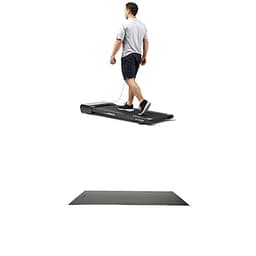
Sunny Health & Fitness TreadPad Sleek Stride (SF-T722069)
Motorized incline
The only pad here with a motorized incline you can change while walking, and the only maker that publishes the deck-to-floor height you actually need for desk clearance math.
Price as of October 6, 2026. #ad How we’re funded
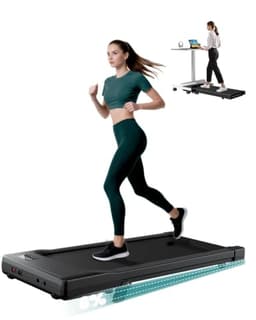
DeerRun Under-Desk Walking Pad
Highest capacity for the money
The cheapest way onto this list with a 300 lb capacity and an incline, and the clearest example of what you give up: no published dimensions at all.
Price as of October 6, 2026. #ad How we’re funded
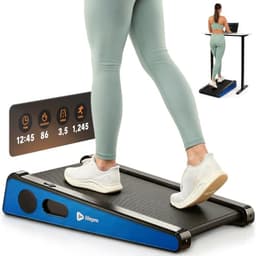
Lifepro PacerMini
Incline in the smallest deck
A 27.6 inch belt is short enough to be a real constraint, but it is the only pad here that publishes both an incline figure and a decibel figure.
Sunny TreadPad Sleek Stride— the only one that can follow the protocol’s shape. Six automatic levels from 1.67 to 3.81 degrees, changed from the remote mid-walk, so the warm-up and cool-down phases are actually possible. Sunny is also the only maker on this site that publishes the deck-to-floor height at each end of the range, 4.1 inches flat and 5.7 at full incline, which is the figure a standing-desk setup needs. The cons are real: it is the heaviest machine on this site at 69.5 lb, Sunny publishes no folded dimensions, and 3.81 degrees is the shallowest published angle of the three.
DeerRun under-desk pad— the only published percent figure in the category, at 6, which puts it at the bottom of the maker’s own suggested beginner range. It also publishes a 300 lb capacity, the highest here, and a 0.6 to 3.8 mph range. Against that: no dimensions of any kind are published, the incline is manual so it is one angle for the whole session, there is no handrail, and the figures come from a retail listing rather than a manufacturer spec page.
Lifepro PacerMini— the steepest published angle of the three at 5 and 7 degrees, and the lightest walking pad on this site at 40 lb, with a published decibel figure which only two pads here have. Two problems for this particular use: the incline is set by swapping the feet by hand, and the 27.6 inch belt is by a distance the shortest we have found — which caps who the machine suits before incline enters the discussion. Its 3.0 mph ceiling is also exactly the protocol’s speed, with no headroom above it.
The full ranking of these three, with the standing-desk clearance arithmetic — and if you were planning to raise one end of a flat pad instead, read this first.
If the 12 percent is the point
Then buy a treadmill built for incline training, and we would rather tell you that than sell you something that cannot do the thing you came for.
Two reasons, and the second matters more than the first. The range: a machine designed for grade work publishes one, in percent, well above anything in this category. And the handrail: it is the component a slope actually requires, and seven of the eight pads we track do not have one.
We do not cover incline treadmills on this site and we are not going to name a model we have not sourced. Worth recording honestly, though: KingSmith’s own 12-3-30 article points readers at its G5i, which it describes as offering an 18 percent adjustable incline across 25 levels, a 0 to 10 mph speed range and support up to 300 lb. That is the same brand whose pads we track, saying plainly that this protocol wants a different machine from the ones in this category. We have not sourced the G5i, it is not in our registry, and we are reporting what the maker says rather than recommending it.
And if what you actually want is more effort rather than more grade, the two levers a walking pad does give you are speed and duration — with the honest ceiling being that at a keyboard your hands cap your pace long before your legs do. What speed to actually set and pad against treadmill, on footprint, deck and speed.
What we have not done
We have not walked on any machine on this site and we have run no comparison of workout protocols. The protocol’s three numbers, its origin, its warm-up and cool-down phases and its 6 to 8 percent modification are all from the article named below, with the date we read it. The incline, speed, belt, weight and capacity figures are each maker’s own, in each maker’s own unit, with no conversion performed. We make no claim about what any grade will do for you. The full method.
Questions people actually ask
Can you do 12-3-30 on a walking pad?
Not as specified. The workout asks for a 12 percent incline, and no walking pad we track publishes an incline figure at or above 12 percent - only one of the eight publishes an incline in percent at all, the DeerRun at 6 percent. The 3 mph and the 30 minutes are both comfortably within reach on these machines; it is the number that does the actual work that is out of range.
What is the 12-3-30 workout?
A treadmill routine of walking at a 12 percent incline, at 3 mph, for 30 minutes. KingSmith's own write-up of it records that it was created by fitness influencer Lauren Giraldo in 2019 and spread through social media on the strength of how simple the formula is. We are not reproducing the outcome claims that usually travel with it - this page is about whether the settings exist on the machines we cover.
What is the closest you can get on a walking pad?
The maker's own fallback is the useful answer here. KingSmith's write-up says that if you are new to incline walking, starting at 6 to 8 percent is a sensible modification, and that the goal is to complete the 30 minutes with good form rather than to match the exact settings. The DeerRun publishes 6 percent, which lands at the bottom of that range - with the significant caveat that DeerRun publishes no dimensions at all, so you cannot check it against your space.
Which walking pads have an incline you can change while walking?
One, of the three that publish an incline at all: the Sunny Health & Fitness TreadPad Sleek Stride, with six automatic levels from 1.67 to 3.81 degrees changed from the remote. On the Lifepro PacerMini and the DeerRun the incline is manual - set by hand before you start - which means the warm-up-then-incline-then-cool-down structure the protocol describes cannot be followed on either of them at all.
Is 30 minutes too long for a walking pad?
No, and there is a published figure to check that against rather than a guess. KingSmith's FAQ states a limit of one hour at a time for a walking machine, followed by about half an hour off. A 30 minute session plus the 5 minute warm-up and 5 minute cool-down the protocol describes comes to 40 minutes, which sits inside that published limit with room to spare.
Should I buy a treadmill instead?
If the 12 percent specifically is the point, then yes, and we would rather say so than sell you a machine that cannot do it. A treadmill built for incline training has the range and, more importantly on a slope, a handrail - and seven of the eight pads we track publish no handrail of any kind. We do not cover incline treadmills on this site. KingSmith itself points readers of its 12-3-30 article at its G5i, an 18 percent incline machine we do not carry and have not sourced.
Does the pad's display know it is on an incline?
On a motorized incline it plausibly does, because the machine set the angle itself. On a manual one it cannot - the electronics have no way to know the deck has been tilted by hand, so any calorie figure on the display is computed as though you were walking on the flat. That is one more reason the manual-incline machines are a poor fit for a protocol defined by its grade.
Read next
- Best walking pads with incline — the three published figures, ranked, with what a raised deck costs a standing desk.
- Can you add incline to a walking pad? — the obvious workaround, and the three mechanical reasons against it.
- Walking pad incline vs flat — whether the incline is worth the deck height in the first place.
- What speed should you set a walking pad to? — the lever that is free, and the real ceiling at a keyboard.
- How long should you walk on a walking pad? — the public activity guidance, and the maker's own one-hour machine limit.
- Are walking pad calorie counts accurate? — why a hand-tilted deck is invisible to the display doing the arithmetic.
- Walking pad vs treadmill — the honest comparison if the 12 percent is non-negotiable.
- Walking pad overheating or getting hot — the published one-hour limit this page checks the 30 minutes against.
- Sunny TreadPad Sleek Stride review — the only pad here whose incline you can change while walking.
- How we rank these — why this page refuses to convert degrees into percent for you.
Sources
- KingSmith / WalkingPad — “What Is the 12-3-30 Treadmill Workout”: the 12 percent / 3 mph / 30 minute formula, its origin with Lauren Giraldo in 2019, the 5 minute flat warm-up at 2.5-3 mph, the 1-2 percent cool-down, the “6% to 8% is a sensible modification” fallback, and the G5i's stated 18 percent incline across 25 levels (read 2026-10-06)
- KingSmith / WalkingPad — brand FAQ: the one-hour continuous-use limit for a walking machine with a half-hour cool-down, and the list of models in the range that offer incline (none of the four we track) (read 2026-10-06)
- Sunny Health & Fitness TreadPad Sleek Stride (SF-T722069) — sunnyhealthfitness.com product spec table, published incline in the maker's own unit plus top speed, belt, unit weight and capacity (read 2026-07-24)
- DeerRun Under-Desk Walking Pad — Amazon retail listing, published incline in the maker's own unit plus top speed, belt, unit weight and capacity (read 2026-07-24)
- Lifepro PacerMini — Rehabmart retail listing spec table, published incline in the maker's own unit plus top speed, belt, unit weight and capacity (read 2026-07-24)
- WalkingPad Z1 — product spec table, checked for an incline figure; none published (read 2026-08-18)
- UREVO Strol 2E — product spec table, checked for an incline figure; none published (read 2026-08-18)