WalkingPad A1 Pro vs P1
Two machines from the same maker with the same belt, the same fold and the same footprint. Four numbers separate them, and only two of those four will matter to you.
By Stephen V. · Last updated
Take the A1 Pro if the machine lives in a room you work or take calls in: it is the only KingSmith pad with a published decibel figure, and it carries 10 lb more. Take the P1 if your day is mostly typing: 0.3 mph is the slowest crawl on this site, and the A1 Pro will not go below 0.5.
How this page is funded: the buy links here are Amazon affiliate links, and we earn a commission if you buy through one — at no extra cost to you. It does not change what we rank first, because the commission rate is the same across every machine on this page. Full disclosure.
The table first
| Model | In use (L x W x H) | Folded (L x W x H) | Belt (L x W) | Unit weight | Max user | Published noise |
|---|---|---|---|---|---|---|
| WalkingPad A1 Pro | 56.5" L x 21.5" W x 5" Hmanufacturer spec | 32.5" L x 21.5" W x 5" Hmanufacturer spec | 47" L x 16.5" Wmanufacturer spec | 63 lbmanufacturer spec | 230 lbmanufacturer spec | Under 65 dBmanufacturer spec |
| WalkingPad P1 | 56.5" L x 21.5" W x 5" Hmanufacturer spec | 32.5" L x 21.5" W x 5" Hmanufacturer spec | 47" L x 16.5" Wmanufacturer spec | 62 lbmanufacturer spec | 220 lbmanufacturer spec | Not publishednot published |
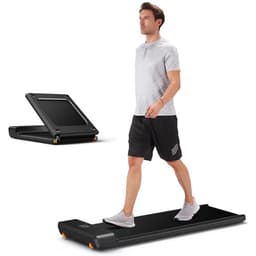
WalkingPad A1 Pro
A published noise figure
One of only two pads on this site whose maker publishes a decibel figure at all, and the only KingSmith model that does.
Price as of October 2, 2026. #ad How we’re funded
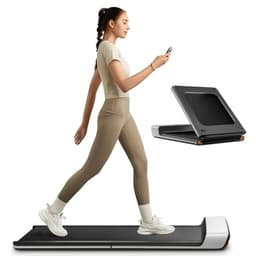
WalkingPad P1
Wider belt in a folding pad
A 16.5 inch belt on a pad that still folds to 32.5 inches — the wider walking surface is the reason to pick it over the Z1.
Everything that is the same, so you can stop comparing it
Most comparisons of these two machines spend four hundred words on specifications that are byte-for-byte identical on KingSmith’s own pages. Here they are once, so you can ignore them:
- Footprint in use: 56.5 x 21.5 x 5 in on both.
- Folded: 32.5 x 21.5 x 5 in on both. Neither gets shorter or taller than the other when stowed.
- Belt:47 x 16.5 in on both — the widest in the KingSmith range.
- Top speed: 3.75 mph on both.
- Incline: neither has one, and neither publishes a figure.
- Handrail: neither has one.
If storage, desk clearance or stride length is your constraint, these two machines are interchangeable and you should choose on price alone. Where a 32.5 inch folded length actually fits.
Difference 1: the A1 Pro has a number for noise
KingSmith publishes “under 65 dB” for the A1 Pro and publishes nothing at all for the P1, the Z1 or the C2. Of the eight walking pads on this site, exactly two have a decibel figure of any kind, and this is one of them.
Be precise about what that buys you. There is no stated test distance, no belt speed, no user weight and no floor surface behind the figure, so it is not comparable with the Lifepro PacerMini’s “less than 60 dB” and it is not a measurement in the sense a meter would give you. What it is, is a commitment in writing from the manufacturer — which is more than six of the eight makers here were willing to give.
It also answers the wrong question for one of the two rooms people buy these for. In a home office, airborne motor noise is the whole problem and a published figure is genuinely useful. In an apartment, the complaint comes from downstairs, and what reaches them is footfall energy through the floor structure rather than motor noise through the air. The full argument, with what each figure does and does not describe.
Difference 2: the P1 starts at 0.3 mph
Reading KingSmith’s own spec tables on 2026-08-18, the P1 is published as 0.3 – 3.75 mph and the A1 Pro as 0.5 – 3.75 mph. Both listings lead with the top speed, and the top speed is the number that will not matter to you.
Typing accuracy degrades with pace well before walking becomes hard work, so the useful range at a desk sits at the bottom of the dial. 0.3 mph is a shuffle — it is the slowest published start on this site, by a clear margin over most of the field, and it is the setting that lets you keep moving through detailed keyboard work instead of stepping off.
0.2 mph sounds like nothing. As a proportion of the useful desk range it is not nothing at all: it is the difference between a machine whose slowest setting is already a walk and one whose slowest setting is barely movement. Why minimum speed is the specification to check.
Difference 3: 10 lb of capacity, and a variant the P1 does not have
230 lb against 220 lb. On its own that is a marginal difference and it only decides anything if you are within about 20 lb of either figure — in which case it decides everything, because a published capacity is the one figure on a spec sheet you should never treat as approximate.
The more useful point is that KingSmith sells the A1 Pro in a 300 lb capacity variant alongside the standard model, and offers no equivalent for the P1. If capacity is your constraint, the A1 Pro is not 10 lb better than the P1, it is a line with somewhere to go. Every published capacity on this site, ranked.
Difference 4: the motor figures, which do not compare
Read on 2026-08-18, KingSmith publishes the A1 Pro’s motor as 3.75 HP brushless and the P1’s as 746 W. Both machines are 110 V.
746 W is exactly one horsepower. So the same manufacturer, on the same website, describes two machines with the same belt and the same top speed as 3.75 HP and 1 HP. Those figures are not measuring the same thing — one is a peak or marketing number and the other looks like a rated input — and neither page says which.
Our conclusion is not that one motor is better. It is that the motor specification in this category is not comparable, even inside a single brand, and should not be a factor in choosing between these two. What those numbers imply about running cost, where a genuine 3.75 HP draw at 110 V would need roughly 25 amps.
So which one
Buy the A1 Pro ifthe pad lives in a room where you are the listener — a home office, a shared room, anywhere you take calls — or if you are near the top of the capacity range. The published decibel figure is the only piece of noise evidence available in the KingSmith range, and the 300 lb variant exists.
Buy the P1 if the machine is primarily a typing machine. The 0.3 mph floor is a real, daily difference in what work you can do while it runs, and it is the specification most likely to decide whether the pad is still out in six months.
Buy neither if your constraint is storage or carry weight. At 62 and 63 lb these are the two heaviest KingSmith pads, and the Z1 folds 0.7 inches shorter and weighs 11 lb less — at the cost of 0.8 inches of belt width.
We have not walked on either machine. Everything above is read from KingSmith’s published specification tables on the dates in the sources below, and the arithmetic is arithmetic you can redo. Our full method.
Questions people actually ask
What is the difference between the WalkingPad A1 Pro and the P1?
Physically, almost nothing. Both publish a 56.5 by 21.5 by 5 inch footprint in use, both fold to 32.5 by 21.5 by 5 inches, both carry the same 47 by 16.5 inch belt, and both top out at 3.75 mph. The differences are four: the A1 Pro publishes 'under 65 dB' and the P1 publishes no noise figure at all; the A1 Pro carries 230 lb against the P1's 220 lb; the A1 Pro weighs 63 lb against 62 lb; and the P1 starts at 0.3 mph while the A1 Pro starts at 0.5 mph.
Which is quieter, the A1 Pro or the P1?
Nobody knows, including us. The A1 Pro is the only KingSmith pad with a published decibel figure — 'under 65 dB' — and the P1 has none, which is not the same as the P1 being louder. KingSmith states no test distance, belt speed, user weight or floor surface behind the A1 Pro figure, so it is a commitment rather than a measurement. If a room you take calls in is the use case, the machine with a number attached is the safer choice; if the person downstairs is the concern, neither figure is describing the noise that reaches them.
Is the WalkingPad P1's 0.3 mph starting speed worth it?
If your main use is typing while walking, yes, and it is the strongest single argument on this page. 0.3 mph is the slowest published starting speed on this site — a genuine shuffle rather than a walk — and it gives you a setting where your hands stay steady while you are still moving. Most machines here begin between 0.5 and 1 mph, which is already a walking pace. If you mainly take calls, read or attend meetings on the machine, the 0.2 mph difference at the bottom of the dial will not matter to you.
Which has the higher weight capacity?
The A1 Pro, at 230 lb against the P1's 220 lb — and KingSmith also sells a 300 lb capacity variant of the A1 Pro alongside the standard model, which the P1 has no equivalent of. If you are within 20 lb of either published figure, the A1 Pro line is the one with headroom.
Do the A1 Pro and P1 have the same belt?
Yes — 47 by 16.5 inches on both, per KingSmith's own spec tables. That is the widest belt in the KingSmith range, 0.8 inches wider than the Z1 and the C2, and it is the reason both of these machines suit someone who drifts sideways while reading a screen. Neither has a handrail.
Read next
- WalkingPad A1 Pro review — the only KingSmith pad with a decibel figure, and what that figure is worth.
- WalkingPad P1 review — the widest KingSmith belt and the slowest crawl on the site.
- WalkingPad C2 vs P1 — the other KingSmith fork - a gap to fit, or a stride to fit.
- Best walking pads for a home office — the ranking where a published decibel figure is the right criterion.
- What speed should you set a walking pad to? — why the bottom of the range decides more than the top.