WalkingPad C2 vs A1 Pro
The narrowest pad we track against the only KingSmith that will state a noise figure. The speed range on the two listings points one way, and the number that actually decides a desk purchase points the other.
By Stephen V. · Last updated
Take the C2 if the machine has to fit a specific gap: 20.4 inches wide is the narrowest on this site. Take the A1 Pro if you type while you walk, or the room is shared. It starts at 0.5 mph against the C2’s 1 mph, and it is the only KingSmith model with a published decibel figure of any kind.
How this page is funded: the buy links here are Amazon affiliate links, and we earn a commission if you buy through one — at no extra cost to you. It does not change what we rank first, because the commission rate is the same across every machine on this page. Full disclosure.
The table first
| Model | In use (L x W x H) | Folded (L x W x H) | Belt (L x W) | Unit weight | Max user | Published noise |
|---|---|---|---|---|---|---|
| WalkingPad C2 | 56.9" L x 20.4" W x 4.9" Hmanufacturer spec | 32.5" L x 20.4" W x 5.4" Hmanufacturer spec | 47.2" L x 15.7" Wmanufacturer spec | 55 lbmanufacturer spec | 220 lbmanufacturer spec | Not publishednot published |
| WalkingPad A1 Pro | 56.5" L x 21.5" W x 5" Hmanufacturer spec | 32.5" L x 21.5" W x 5" Hmanufacturer spec | 47" L x 16.5" Wmanufacturer spec | 63 lbmanufacturer spec | 230 lbmanufacturer spec | Under 65 dBmanufacturer spec |
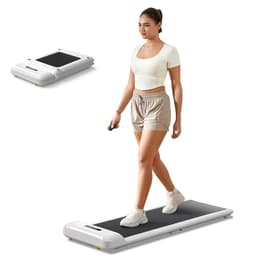
WalkingPad C2
Narrowest closet fit
The narrowest pad we list at 20.4 inches wide, which is the one that fits a genuinely tight closet — you pay for it in belt width.
Price as of October 22, 2026. #ad How we’re funded
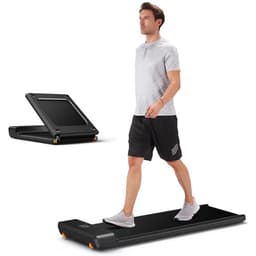
WalkingPad A1 Pro
A published noise figure
One of only two pads on this site whose maker publishes a decibel figure at all, and the only KingSmith model that does.
Price as of October 22, 2026. #ad How we’re funded
The speed range is printed backwards for this buyer
Read from KingSmith’s own technical parameters on 2026-09-01, the two machines publish:
- C2 — 1 to 4 mph.
- A1 Pro — 0.5 to 3.75 mph.
Every listing in this category leads with the top speed, and by that measure the C2 wins: 0.25 mph faster, on the cheaper machine. It is also the number least likely to matter to you. Nothing here is a running treadmill, 4 mph is a brisk walk you will use rarely, and the gap between 3.75 and 4 is a rounding error in practice.
The bottom of the range is the part you live in, and there the same two machines are twice apart. The C2 will not go below 1 mph. The A1 Pro will go to 0.5. That is the difference between a machine whose slowest setting is already a walk and one whose slowest setting is barely movement, and it decides what work you can do while the belt is running.
Typing accuracy falls away with pace long before walking gets hard. If your day is calls, reading and meetings, 1 mph is fine and the C2 costs you nothing. If your day is detailed keyboard work, the C2 asks you to choose between walking and typing well, and the A1 Pro does not. Why the minimum is the speed specification to check.
For scale inside the same range: the WalkingPad P1 publishes 0.3 mph and the Z1 publishes 1 mph. So the C2 shares the highest floor in the KingSmith line-up, and the A1 Pro sits in the middle of it.
1.1 inches of machine buys 0.8 inches of belt
This is the trade the two machines are really built around, and it is worth doing as arithmetic rather than as adjectives.
The C2 is 20.4 inches wide and carries a 15.7 inch belt. The A1 Pro is 21.5 inches wide and carries a 16.5 inch belt. So the extra 1.1 inches of machine returns 0.8 inches of walking surface — about three quarters of the width you give up to the room comes back under your feet, and the rest goes into the side rails.
Which way that trade falls is not a matter of taste, it is a matter of which constraint is real in your home:
- If a gap decides it, take the C2. 20.4 inches is the narrowest machine on this site, and the difference between fitting a 21 inch alcove and not fitting it is absolute. There is no partial credit on a gap.
- If drift decides it, take the A1 Pro. 16.5 inches is the widest belt KingSmith makes, and the people who need it know who they are — if you read a screen while you walk, you wander sideways, and a 15.7 inch belt gives you less than an inch of margin either side of a normal gait.
Belt length is not a factor here: 47.2 inches on the C2 against 47 on the A1 Pro, which is two tenths of an inch and decides nothing. Every published dimension on this site, side by side.
The folded-height inversion nobody mentions
Here is the one that catches people, and it is entirely in KingSmith’s published figures.
The C2 is 4.9 inches tall in use and 5.4 inches tall folded. It gets half an inch taller when you put it away. The A1 Pro is 5 inches in both states.
So the ranking flips depending on which problem you have. Under a desk with the machine running, the C2 is the lower of the two by a tenth of an inch. Slid under a sofa with the machine folded, the A1 Pro is the lower of the two by four tenths. On a sofa that clears six inches, both fit; on one that clears five and a quarter, only the A1 Pro does.
Both fold to the same 32.5 inch length, so the standing-in-a-closet question is a tie and comes down to the same 1.1 inches of width as everything else. Every folded footprint against a real sofa, bed, closet and door gap.
The decibel figure, and where it actually appears
KingSmith states that the A1 Pro’s motor operates at under 65 dB, and publishes nothing at all for the C2. Of the eight walking pads on this site, two have a decibel figure of any kind, and the A1 Pro is the only KingSmith among them.
Two things about that claim, both of which we would want to know before paying for it. First, it carries no test distance, no belt speed, no user weight and no floor surface, so it is a commitment rather than a measurement and it is not comparable with the Lifepro PacerMini’s “less than 60 dB”. Second — reading the A1 Pro page on 2026-09-01 — it appears as a line of body copy rather than as a row in the technical parameters table, which is a softer place for a number to live than the table the rest of the specification is in.
None of that makes it worthless. Six of eight makers here would not put any figure in writing at all, and a stated ceiling from the manufacturer is evidence of a kind. It just is not the evidence a decibel figure looks like.
It also answers the wrong question for one of the two rooms people buy these for. In a home office you are the listener and airborne motor noise is the whole problem, so a published figure is genuinely useful. In an apartment the complaint comes from downstairs, and what reaches them is footfall energy through the floor structure rather than motor noise through the air — neither of these machines publishes anything about that, and no maker does. What a walking pad decibel figure does and does not describe.
Capacity, carry weight, and the variant the C2 does not have
Published capacity is 220 lb on the C2 and 230 lb on the A1 Pro, and KingSmith sells the A1 Pro in a 300 lb capacity option alongside the standard model. There is no equivalent for the C2.
Ten pounds on its own is marginal and only decides anything if you are close to the line — in which case it decides everything, because a rated maximum is the point at which the maker stops standing behind the machine rather than a comfortable operating point. The more useful way to read it is that the A1 Pro is a line with headroom and the C2 is a single figure. Every published capacity on this site, and which ones to trust.
The cost runs the other way and it is bigger than the capacity gain. The C2 weighs 55 lb and the A1 Pro 63 lb. You carry eight more pounds to be allowed ten more, and 63 lb is the heaviest pad KingSmith makes — the difference between a machine you slide out from under the sofa one-handed each morning and one you think about first. What each of those weights means on a staircase.
The motor ratings, which do not compare
Read on 2026-09-01, KingSmith publishes the C2’s motor as 3 HP brushless and the A1 Pro’s as 3.75 HP brushless.
Now put that next to the speeds on the same two pages: the 3 HP machine tops out at 4 mph and the 3.75 HP machine tops out at 3.75. The smaller number is on the faster pad, with a belt two tenths of an inch longer and eight pounds lighter to carry.
We are not going to tell you which motor is better, because the published figures do not support any such conclusion. What we will say is that a horsepower rating in this category is not a specification you can rank two machines on, and that this is not an isolated oddity — across four KingSmith pads the same maker publishes 0.75 HP, 3 HP, 3.75 HP and 746 W for machines with almost the same belt. The brand-by-brand version of that finding.
So which one
Buy the C2 if a measured gap is the constraint. It is the narrowest pad we track, it is the lower of the two while you are standing on it, and at eight pounds lighter it is the easier one to move every day. Accept that you are buying the higher speed floor and no noise figure.
Buy the A1 Pro if you type while you walk, or the machine lives in a room where somebody is listening, or you are near the top of the capacity range. 0.5 mph, a published decibel ceiling and a 300 lb option are three genuinely different things the C2 does not offer — and the A1 Pro is the most expensive pad on this site, so be sure at least one of the three is yours.
Buy neither if storage is the whole problem. Both fold to 32.5 inches, but the Z1 folds to 31.8 inches and weighs 51 lb, which is shorter and lighter than either machine here, at the cost of the A1 Pro’s belt width and with the same 1 mph floor as the C2.
We have not walked on either machine. Everything above is read from KingSmith’s published specification pages on the dates in the sources below, and every piece of arithmetic on this page is arithmetic you can redo. Our full method.
Questions people actually ask
What is the difference between the WalkingPad C2 and the A1 Pro?
Four things, and only two of them will decide it for you. The C2 is 20.4 inches wide against the A1 Pro's 21.5, which makes it the narrowest pad we track. The A1 Pro's belt is 16.5 inches wide against the C2's 15.7. The A1 Pro is the only KingSmith model with any published decibel figure. And the speed ranges are the reverse of what the prices suggest: KingSmith publishes 1 to 4 mph for the C2 and 0.5 to 3.75 mph for the A1 Pro, so the C2 is faster at the top and twice as fast at the bottom.
Which is better for typing while you walk, the C2 or the A1 Pro?
The A1 Pro, and it is not close. Its published minimum is 0.5 mph against the C2's 1 mph, and at a desk the bottom of the range is the part you live in. 1 mph is a walk; 0.5 mph is a shuffle you can type through. If most of your walking happens during detailed keyboard work rather than calls or reading, that single figure is worth more than everything else on this page.
Is the WalkingPad C2 smaller than the A1 Pro?
In use, yes, and when folded it is a split decision. The C2 is 1.1 inches narrower and 0.1 inches lower in use, which is why it is the pad we point at a genuinely tight gap. But folded it grows: KingSmith publishes 5.4 inches folded for the C2 against 4.9 in use, while the A1 Pro stays at 5 inches in both states. So the C2 is the lower machine under a desk and the taller one under a sofa, by 0.4 inches.
Is the A1 Pro quieter than the C2?
Nobody has published anything that would let you say so. KingSmith states the A1 Pro's motor operates at under 65 dB and publishes no figure at all for the C2, which is not the same as the C2 being louder. Note also where that claim lives: on the A1 Pro page it is a line of body copy rather than a row in the technical parameters table, and it carries no test distance, belt speed, user weight or floor surface. It is a commitment in writing, which is more than most makers give, and it is not a measurement.
Which has the higher weight capacity, the C2 or the A1 Pro?
The A1 Pro. KingSmith publishes 220 lb for the C2 and sells the A1 Pro in two capacity options, 230 lb and 300 lb. If you are within about 20 lb of the C2's figure, the A1 Pro line is the one with somewhere to go — a published capacity is the one number on a spec sheet you should never treat as approximate.
Do the C2 and A1 Pro have the same motor?
They have the same brand and two figures that cannot be compared. KingSmith publishes 3 HP brushless for the C2 and 3.75 HP brushless for the A1 Pro, and the machine with the smaller number has the higher published top speed. Whatever those ratings describe, it is not something you can rank two walking pads on, and we would not let either figure decide this purchase.
Read next
- WalkingPad C2 review — the narrowest machine on the site, and what the 20.4 inch width costs under your feet.
- WalkingPad A1 Pro review — the only KingSmith with a decibel figure, and what that figure is actually worth.
- WalkingPad Z1 vs C2 — the other side of the C2 decision - 1.6 inches of width against 0.7 inches of fold.
- WalkingPad A1 Pro vs P1 — the same belt on both, and the 0.3 mph floor that beats this page's 0.5.
- Best walking pads for small spaces — the roundup the C2 leads, ranked on folded footprint rather than on belt.
- Best walking pads for a home office — the ranking where a published decibel figure is the right thing to rank on.
- What speed should you set a walking pad to? — why 0.5 mph against 1 mph is the biggest number on this page.
Sources
- WalkingPad C2 — walkingpad.com product spec table (read 2026-07-24, speed range and motor re-read 2026-09-01)
- WalkingPad A1 Pro — walkingpad.com product spec table (read 2026-07-24, speed range, motor and noise claim re-read 2026-09-01)
- WalkingPad Z1 — speed range and motor rating, for the range comparison (read 2026-09-01)