Walking pad vs walking outside
We sell walking pads, so here is the uncomfortable part first: outside is better movement and it costs nothing. The case for the machine is about consistency, not quality.
By Stephen V. · Last updated
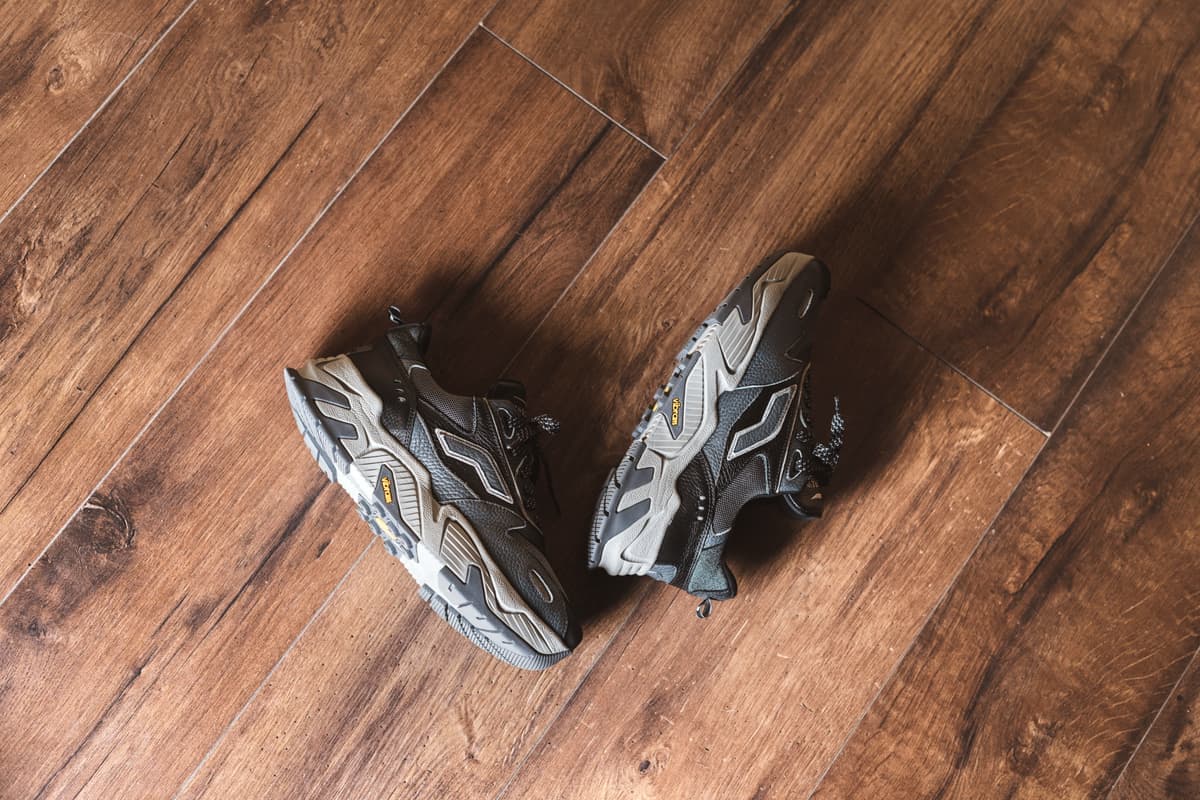
Outside is the better walk— gradient, uneven ground, turning, daylight, no cost. The pad wins on consistency: it removes weather, daylight, route and travel time, and it runs while you work. If you already walk outdoors most days, you do not need one.
How this page is funded: the buy links here are Amazon affiliate links, and we earn a commission if you buy through one — at no extra cost to you. It does not change what we rank first, because the commission rate is the same across every machine on this page. Full disclosure.
Outside is the better movement, and here is why
Four differences, none of which any machine on this site can reproduce:
The ground is not flat. Camber, curbs, gradient, gravel, grass. Your ankles, hips and stabilizing muscles are working constantly to handle a surface that changes every step. A belt is the same surface at the same angle for the entire session.
You change pace without deciding to. Crossings, corners, hills, other people. That natural variation is a kind of interval training you get for free and never notice.
You turn. Walking in a straight line for thirty minutes uses a narrower range of motion than a route with corners in it.
You are outside. Daylight, weather, changing scenery and getting somewhere. We are not going to make health claims about this beyond the obvious: people report enjoying it more, and enjoyment is what makes a habit survive January.
Any page selling you a walking pad that skips this section is not being straight with you.
The pad is not competing with your best walk
Here is the argument that actually holds. The relevant comparison is not pad versus outdoor walk. It is pad versus what you did instead.
For someone working from a desk in a city apartment in February, the realistic alternatives to twenty-five minutes on a pad at 1.6 mph are not usually twenty-five minutes in a park. They are: sitting; meaning to go out later; going out at the weekend instead; or the walk you take from the sofa to the kitchen.
Every barrier the machine removes is real. No shoes to put on, no coat, no route to choose, no daylight requirement, no travel time to and from a nice place to walk, no weather, and no getting home to change afterwards. A twenty-minute outdoor walk frequently costs forty-five minutes; a twenty-minute pad walk costs twenty and can happen inside a meeting.
MedlinePlus puts the target at “at least 150 to 300 minutes of moderate-intensity” aerobic activity a week and notes that “getting some physical activity is always better than getting none”. Those are minutes, not miles, and they do not specify a venue. What 150 minutes looks like at desk pace.
The property outdoor walking cannot have
There is one thing a pad does that no amount of willpower buys you outdoors: it runs at the same time as something else.
You cannot answer email on a canal path. You can on a pad, badly, at a slow enough speed — and you can absolutely take a call, sit through a meeting you are only listening to, or read something long. That is time you were going to spend at a desk regardless, converted into movement.
This is also where the machine’s limitations become clear. At typing speed you are walking slowly. Nobody accumulates a brisk 4 mph hour while writing a document. The pad’s hours are low-intensity hours — which is fine, because they are hours you would otherwise have spent seated. Whether that counts as cardio, honestly.
Who genuinely should not buy one
We would rather you kept the money than bought a machine that ends up under a bed. Do not buy a walking pad if:
- You already walk outdoors most days. A pad will add marginal minutes to an existing habit at real cost in money and floor space. Buy better shoes.
- You have a dog. The dog is already solving this problem twice a day and does not accept a belt as a substitute.
- Your commute involves walking. Twenty minutes each way to a station is 200 minutes a week, which is inside the published guidance on its own.
- You want the machine to make you exercise. It will not. It removes friction from a decision you still have to make.
- There is nowhere for it to live. A pad that has to be dragged out from behind a wardrobe gets used for three weeks. Check the folded size against a real gap first.
The answer most people end up at
Both, with the pad doing the unglamorous work. The pattern that seems to survive contact with a real year:
Outdoors when it is available. Weekends, light evenings, anything with a destination. That is the better walk and it stays the priority.
The pad for the rest. The dark half of the year, the day with back-to-back calls, the evening it is raining sideways. Its job is to stop the streak breaking, not to be the best form of walking available.
Framed that way, the purchase question is not “is this as good as outside”. It is “how many weeks a year does weather, daylight or a schedule stop me walking” — and if the answer is more than a handful, a machine that costs the equivalent of a few months of a gym membership is straightforwardly worth it. The full worth-it argument, scoped to a small apartment.
If you decide on a pad
Two machines, for the two versions of this decision. Neither has been walked on by us — every figure comes from the maker’s published specification, dated below.
If the pad is a supplement to outdoor walking, the WalkingPad Z1 is the one to get: 31.8 inches folded is the shortest on this site, 5.4 inches tall goes under a bed, and 51 lb is manageable. A machine used three days a week has to disappear on the other four.
If the pad is replacing outdoor walking entirely — a genuine winter, a very high floor, an area you do not want to walk in after dark — the UREVO Strol 2E is the one that stretches furthest: 6.2 mph is jog-capable, it has a safety handle, and at 47.2 lb it is the lightest pad we track. Its 40.2 inch belt is the shortest of the full-size pads, which is the trade.
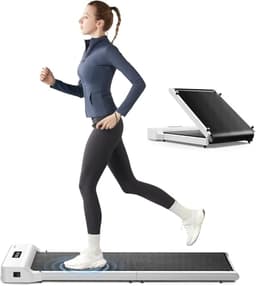
WalkingPad Z1
Smallest storage footprint
The only pad here that folds in half AND stays under 5.5 inches folded, which is the combination a small apartment actually needs.
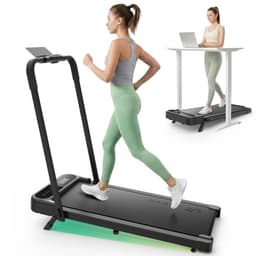
UREVO Strol 2E
Lightest with a handle
The lightest machine here that still has a safety handle, and the only one that goes fast enough to jog on.
Questions people actually ask
Is a walking pad as good as walking outside?
As a movement, no — outdoor walking involves gradient, uneven surfaces, turning, wind and changing pace, and your body handles all of it. A belt moving at a constant speed on a flat deck asks for less. As a habit, the pad often wins, because it removes every reason not to walk: no weather, no daylight, no shoes, no route and no travel time. The best exercise is still the one that happens.
Why would anyone buy a walking pad if walking outside is free?
Because the pad is not competing with your best walk, it is competing with the walk you did not take. For most desk workers the realistic alternative to twenty minutes on a pad at 1.5 mph is not twenty minutes outside — it is sitting. A pad also stacks with work in a way outdoor walking cannot: you can do it during a call, a meeting or an hour of reading, which is time you were never going to spend outdoors anyway.
Do you burn fewer calories on a walking pad than walking outside?
Probably somewhat fewer at the same speed and duration, because outdoor walking adds air resistance, gradient changes and surface variation, and there is no belt assisting your foot's rearward travel. We are not going to attach a percentage to that: the number depends on your weight, your terrain and your pace, and neither our site nor your machine's console knows any of those. What the pad can do is add up more minutes, and duration is the lever that matters most.
Can you use a walking pad outside?
No. These are indoor machines with electronics that are not sealed against moisture, and the manuals are consistent about indoor use. Beyond the electrical risk, an outdoor surface is rarely flat enough for a low-clearance deck, and grit dragged onto the belt is exactly what wears one out. If you want to be outside, walk outside.
Is walking in place as good as walking on a pad?
Walking in place asks less again — there is no forward travel, the range of motion is smaller, and most people slow down without noticing because nothing is setting the pace. That last part is the underrated thing a walking pad does: the belt keeps a speed you did not choose moment to moment, so the session does not quietly decay. It is the same reason a metronome works better than counting.
How much walking should I be doing?
MedlinePlus, from the US National Library of Medicine, says adults should get at least 150 to 300 minutes of moderate-intensity aerobic physical activity each week, and that some activity is always better than none. Note that this is written in minutes per week rather than steps per day, and it does not care where those minutes happen — which is the whole argument for whichever option you will actually accumulate them on.
Read next
- Are walking pads worth it? — the same honesty, applied to the money rather than the movement.
- How long should you walk on a walking pad? — what the published weekly guidance means at typing pace.
- Is a walking pad good cardio? — what desk pace does and does not qualify as.
- Best walking pads for apartments — if the machine is the answer, these are the ones that fit one.
- Do walking pads help you lose weight? — the arithmetic on what a realistic day actually adds.