Cubii Move vs Stamina InMotion E1000
The two machines each maker currently lists, and the comparison comes down to one inch and seven-eighths against an entire specification sheet.
By Stephen V. · Last updated

Buy the Stamina InMotion E1000— unless the gap under your desk is tight, in which case buy the Cubii Move. Stamina is the only one of the two whose manufacturer publishes dimensions, a product weight, a 250 lb maximum user weight, a warranty term and a stated use position. The Move wins exactly one row, and for a fixed desk it is the row that matters: 9.5 in tall against 11.38 in.
How this page is funded: the buy links here are Amazon affiliate links, and we earn a commission if you buy through one — at no extra cost to you. It does not change what we rank first, because the commission rate is the same across every machine on this page. Full disclosure.
The table first
| Model | In use (L x W x H) | Unit weight | Max user | Resistance levels |
|---|---|---|---|---|
| Cubii Move | 21.5" L x 19.5" W x 9.5" Hretail listing | 17.5 lbretail listing | Not publishednot published | 6retail listing |
| Stamina InMotion E1000 | 24.5" L x 17" W x 11.38" Hmanufacturer spec | 24 lbmanufacturer spec | 250 lbmanufacturer spec | Not publishednot published |
| DeskCycle Under Desk Bike Pedal Exerciser | 20" L x 24" W x 10" Hmanufacturer spec | Not publishednot published | Not publishednot published | 8manufacturer spec |
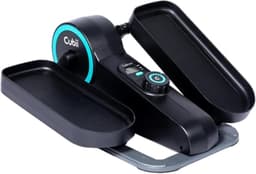
Cubii Move
Lowest published height
The lowest seated machine we have found a published height for, at 9.5 inches — which is the whole argument when your desk apron is the constraint.
Price as of October 20, 2026. #ad How we’re funded
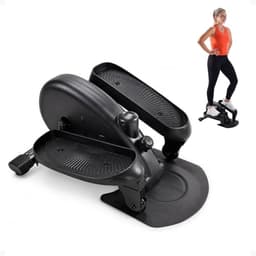
Stamina InMotion E1000
The most complete published spec
The only seated machine here whose maker publishes dimensions, unit weight and a user weight limit together — and the tallest of the three, at 11.38 inches.
Price as of October 20, 2026. #ad How we’re funded
The one row the Cubii wins, and why it can decide the purchase
Start with the figure that is doing all the work, because on a seated machine bought for a desk it is not one specification among several — it is the pass-or-fail test. Your desk height does not change. Whatever the machine is tall, your knee is raised by inside a gap that stayed the same.
Against a standard 27 inch desk, the published heights work out like this: the Cubii Move at 9.5 in leaves 17.5 in of room above the machine, and the Stamina at 11.38 in leaves 15.6 in. That is a difference of 1.88 in, which sounds trivial written down and is not: it is the difference between a thigh that clears the desk apron and one that does not, and the apron is usually an inch or two below the worktop. The clearance arithmetic for every machine, with the four measurements to take first.
So the honest version of this comparison is not “which machine is better”. It is: measure the gap under your own desk before you read any further. If you have less than about sixteen inches of clear height, the Stamina is not a candidate and nothing else on this page matters. If you have more, or if the machine is going in front of an armchair where there is nothing above it at all, then everything else on this page matters and the Move loses the rest of them.
The Move takes two lesser rows as well, and we are not going to inflate them. It publishes six resistance levels where Stamina publishes no level count at all, and 17.5 lbagainst 24 lb — the lightest machine of any kind on this site. The level count is the weaker of the two: it is a count of knob positions, not a statement of how hard anything is, and only one machine in this whole category publishes the magnitude.
Then the rows where one maker answers and the other does not
Here is where the comparison stops being close. We re-read both makers’ own pages on 2026-10-17, and the pattern is the one this site keeps finding in this category: one company documents its product and the other documents its app.
A maximum user weight: 250 lb against nothing. Stamina states 250 lb on its own product page. Cubii publishes no maximum user weight for the Move, or for the Go, or for the Total Body — no figure for any model in its range. On a machine you put your body weight through while pushing against resistance, that is the single most consequential absence in the category, and it rules the Move out for anybody who needs a stated rating rather than an assumption. Every published capacity figure in the seated and standing categories.
Dimensions from the manufacturer: all three against one. Stamina publishes assembled dimensions, product weight and capacity together on its own site. Cubii publishes exactly one of the three. Its own model comparison, re-read on 2026-10-17, gives a product weight of 17.6 lbfor the Move — and prints a Dimensions row with no values in itfor all three machines in its range. So the 21.5 x 19.5 x 9.5 in figure in the table above is a retailer’s, and Cubii has a row for it on its own page and leaves it blank. Note also that Cubii’s 17.6 lb and the retail listing’s 17.5 lb disagree by a tenth of a pound; we print both rather than silently picking one.
A stated use position: two ways against one.This is the functional difference most spec comparisons miss. Stamina states that the frame is rated for standing as well as seated use, and that the pedals reverse. Cubii calls the Move a standard seated elliptical and lists its whole range as seated ellipticals. In each case that is the maker’s own wording. It means one of these machines has a second mode of use the other does not claim, and reversible pedals are the only published way on either machine to change the direction the joint is driven without changing machine. How the use-position question splits this whole category.
A warranty term: 1 year frame and 90 days parts against nothing published.Stamina states it. We found no warranty term published for the Move on Cubii’s own product page on 2026-10-17. Short coverage you can read beats open-ended coverage you cannot.
One row neither of them answers, and it matters on both: neither publishes a stride length. That is the figure from which you could work out how far the knee actually travels, and in a category built on the claim of a low-impact stroke, not one maker we track publishes it. The three geometry figures nobody in this category publishes.
If the resistance is what you care about, buy neither
There is a third machine on this page for a reason. If what you actually want to know is how hard the hardest setting is, both of these will leave you guessing: six unquantified levels on one, the phrase “adjustable tension” on the other.
The DeskCycle is the only machine in this category that answers it. VIVO publishes 8 magnetic settings up to 39 lb of resistance, re-read on 2026-10-17, alongside a steel frame, a 10 in overall height and adjustable pedal straps — the only published foot-retention feature in the category. The trade is that it is a pedal circle rather than an elliptical linkage, so the knee is lifted by the full crank diameter at the top of every turn, and VIVO publishes no crank diameter, no product weight and no maximum user weight.
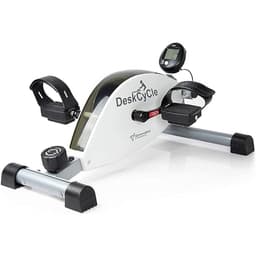
DeskCycle Under Desk Bike Pedal Exerciser
Fitting under a low desk
A 10 inch pedal height is the whole product — it is the seated machine most likely to actually clear a standard 27 inch desk.
Price as of October 20, 2026. #ad How we’re funded
What we have not done
We have not used either machine, measured either stroke or timed either warranty claim. Every figure above is the maker’s own or its retailer’s, labelled as whichever it is, read from the page named in the sources on the date given. Where a figure is absent we have said so rather than estimating one, and we have not converted the absence of a capacity figure into a claim that the machine is weak. The full method.
Questions people actually ask
Is the Stamina InMotion E1000 better than the Cubii Move?
It depends entirely on whether your desk height is the constraint. The Move is 9.5 inches tall and the Stamina is 11.38, so under a standard 27 inch desk the Move leaves about 17.5 inches of knee room and the Stamina about 15.6 - and that 1.88 inch difference is the whole purchase for a lot of buyers. If your desk is adjustable, or you are using the machine in front of an armchair rather than under a desk, the Stamina is the better documented machine by a wide margin: it is the only one of the two whose manufacturer publishes dimensions, a product weight, a maximum user weight and a warranty term.
Which one has a published maximum user weight?
Only the Stamina, at 250 lb, stated on staminaproducts.com beside its dimensions and its 24 lb product weight. Cubii publishes no maximum user weight for any model in its range, including the Move - re-checked on October 17, 2026. That is not a gap in our research; it is the finding. On a machine you put your body weight through, one of these two makers will tell you what it is rated for and the other will not.
Which is lower - the Cubii Move or the Stamina InMotion E1000?
The Cubii Move, at a published 9.5 inches against 11.38. The Move is the lowest seated machine we have found a published height for anywhere, and the Stamina is the tallest of the three under-desk ellipticals we track. Note where the Move's figure comes from, though: Cubii publishes no dimensions at all on its own product page, so the 9.5 inch height is a retailer's figure, while Stamina's 11.38 is the manufacturer's own.
Can you use either of them standing up?
Stamina says yes and Cubii says no. Stamina's own page states that the frame is rated for standing as well as seated use and that the pedals reverse. Cubii describes the Move as a standard seated elliptical and lists its range as seated ellipticals. That is the makers' own wording in both cases, and it is the clearest functional difference between the two machines - it means one of them can be used two ways and the other one way.
Which has more resistance levels?
The Move, at six, and the comparison is less useful than it sounds. Stamina publishes no level count at all for the E1000 - only adjustable tension - so the Move wins a row the Stamina never entered. More importantly, neither figure is a magnitude: six levels tells you how many positions the knob has, not how hard the hardest one is. Exactly one machine in this whole category publishes that, and it is neither of these two.
Which is lighter to move between rooms?
The Move, at a published 17.5 lb against the Stamina's 24 lb - though again the Move's figure is a retailer's and the Stamina's is the manufacturer's. The Move is the lightest machine of any kind on this site. Both are light enough to carry one-handed, so this is the least important row in the table unless the machine has to travel every day.
Which should I buy?
Buy the Stamina InMotion E1000 unless the gap under your desk is tight, and buy the Cubii Move if it is. That is an unusually clean split: the Stamina wins on everything that is written down - dimensions, weight, capacity, use position, warranty, reversible pedals - and loses on the single dimension that decides whether a machine is usable at a fixed-height desk at all.
Read next
- Cubii JR1 vs Stamina InMotion E1000 — the older pairing, where a published 150 lb limit against 250 lb decides it outright.
- Cubii Move vs Cubii JR1 — which Cubii to buy, and the row that is on neither spec sheet.
- Best under-desk ellipticals — the full ranking, built on desk clearance.
- Best under-desk cardio for bad knees — the same machines ranked on the motion path instead of the spec sheet.
- Stamina InMotion E1000 review — the most completely documented seated machine on this site, figure by figure.
- Cubii Move review — the lowest published height in the category, and what Cubii will not state.
Sources
- Stamina - InMotion E1000 product page: 24.5 x 17 x 11.38 in, 24 lb product weight, 250 lb maximum user weight, reversible pedals, use sitting or standing, 1 year frame and 90 days parts warranty; no resistance level count and no stride length published (read 2026-08-11, re-checked 2026-10-17)
- Rehabmart - Cubii Move retail listing spec table: 21.5 x 19.5 x 9.5 in, 17.5 lb, 6 magnetic resistance levels; no maximum user weight (read 2026-08-11)
- Cubii - model comparison page, re-read 2026-10-17: three models listed (Total Body, Go, Move) and no JR1; 6 levels of resistance and a Basic LCD Monitor for the Move; a product weight of 17.6 lb for the Move; a Dimensions row printed with no values for any model; no maximum user weight, no stride length and no warranty term for any model
- VIVO (DeskCycle) - product page, re-read 2026-10-17: 20 x 24 x 10 in, 8 magnetic settings to 39 lb of resistance, steel frame, adjustable pedal straps, 1 year warranty; no product weight and no maximum user weight published