Walking pads and back pain: what the numbers actually say
Every ranking on this site treats deck height as a storage figure. For a back it is the only figure that matters - because you rise by it and your desk does not.
By Stephen V. · Last updated
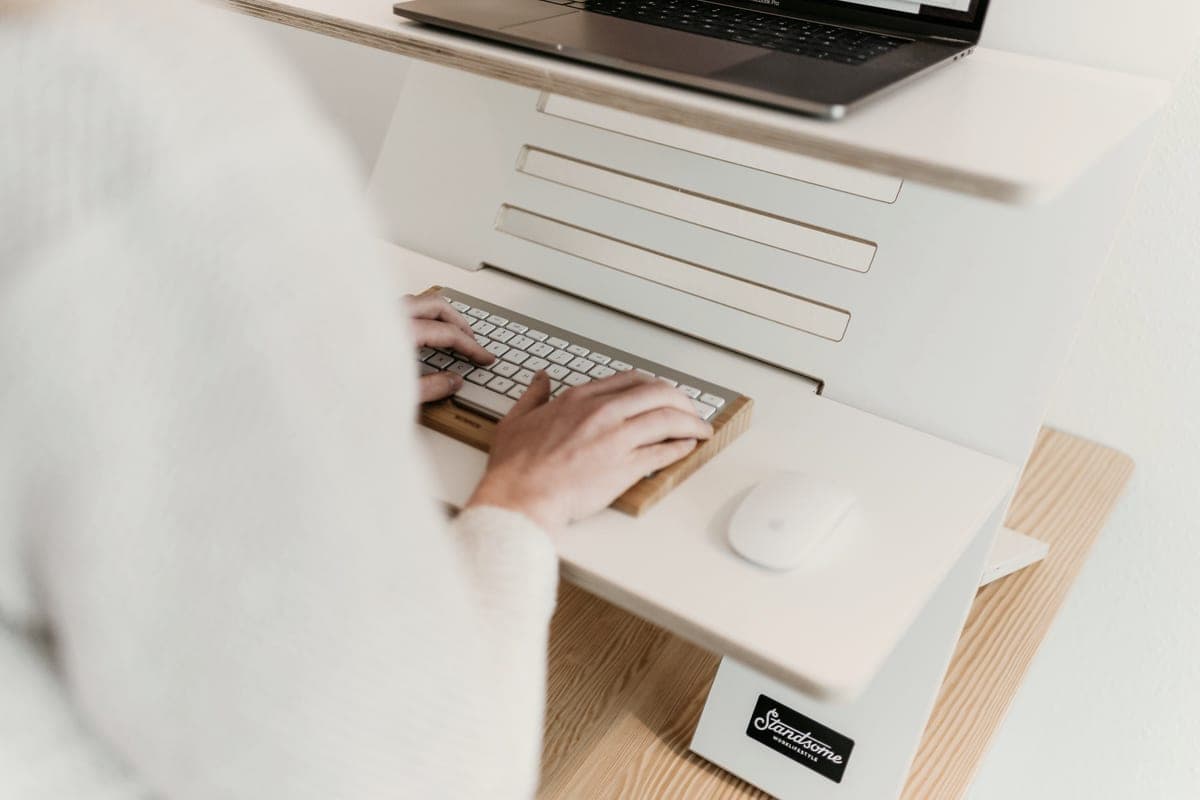
We are not clinicians and this is not medical advice. The mechanical problem the published figures do reveal is this: a walking pad raises you 4.1 to 7 inches, and the tallest maximum height published by any desk sold for a walking pad is 47 inches— which reaches a walker of about 5 ft 9 in on the lowest deck and 5 ft 5 in on the highest. Above those heights you are working bent, and that is a desk problem rather than a belt problem.
The back is a desk problem, not a deck problem
Our page on knees is about the deck, because for a knee the question is what happens when your foot lands. And the answer there is that nobody publishes a cushioning figure. The back is a different question with a much more tractable answer, and almost nobody asks it before buying.
Here is the whole thing in one sentence. You stand on the pad, so you get taller by the deck height, and your desk does not. Whatever worked as a standing-desk height before is now four to seven inches too low. You can either raise the desk by the same amount, or spend the session reaching down to a surface that is below where your hands want to be. That second posture — and the head position that comes with looking down at a laptop that dropped with the desk — is the part people feel in their back and shoulders afterwards.
It is a prerequisite rather than a preference, which is why this site treats the desk as half the purchase. Why the pad-against-standing-desk question is not really a choice.
The arithmetic, with the published figures
Three numbers and one subtraction. Your standing elbow height is roughly where a work surface should be when you are upright: for a 5 ft 10 in person that is about 43.4 inches. Add the deck height of the machine you are standing on. Compare the result with what your desk can actually reach.
The published deck heights across the eight pads we track run from 4.1 in on the WalkingPad Z1 to 7 inon the Lifepro PacerMini — a spread of nearly three inches, which is larger than most buyers expect and larger than the adjustment range on some desks. Two of the eight publish no deck-to-floor height at all, including the UREVO Strol 2E, whose published 38.9 in in-use figure is the raised handle rather than the deck.
Now the number that makes this uncomfortable, which we established when we ranked the desks themselves: the tallest maximum height published by any desk sold for a walking pad is 47 inches. Put the two together and the reach of the whole category is: roughly 5 ft 9 in of walker on the lowest deck we track, and roughly 5 ft 5 in on the highest. A 5 ft 10 in walker is not served by any combination we have found. The desk ranking, with every published maximum height.
If that puts you outside the category, there are two honest responses and neither of them is a different pad. Raise the screen rather than the desk, so at least the neck is upright even if the hands are low. Or accept shorter sessions at a desk that does not fit, which is the trade most people actually make. The setup sequence, in order.
| Model | In use (L x W x H) | Belt (L x W) | Top speed | Unit weight |
|---|---|---|---|---|
| WalkingPad Z1 | 56.1" L x 22" W x 4.1" Hmanufacturer spec | 47.6" L x 15.7" Wmanufacturer spec | 4 mphmanufacturer spec | 51 lbmanufacturer spec |
| WalkingPad C2 | 56.9" L x 20.4" W x 4.9" Hmanufacturer spec | 47.2" L x 15.7" Wmanufacturer spec | 4 mphmanufacturer spec | 55 lbmanufacturer spec |
| WalkingPad P1 | 56.5" L x 21.5" W x 5" Hmanufacturer spec | 47" L x 16.5" Wmanufacturer spec | 3.75 mphmanufacturer spec | 62 lbmanufacturer spec |
| WalkingPad A1 Pro | 56.5" L x 21.5" W x 5" Hmanufacturer spec | 47" L x 16.5" Wmanufacturer spec | 3.75 mphmanufacturer spec | 63 lbmanufacturer spec |
| UREVO Strol 2E | 48" L x 22.6" W x 38.9" Hmanufacturer spec | 40.2" L x 15" Wmanufacturer spec | 6.2 mphmanufacturer spec | 47.2 lbmanufacturer spec |
| Lifepro PacerMini | 32.7" L x 25" W x 7" Hretail listing | 27.6" L x 15.7" Wretail listing | 3 mphretail listing | 40 lbretail listing |
| Sunny Health & Fitness TreadPad Sleek Stride (SF-T722069) | 58.2" L x 24.9" W x 5.9" Hmanufacturer spec | 45.7" L x 16" Wmanufacturer spec | 3.7 mphmanufacturer spec | 69.5 lbmanufacturer spec |
| DeerRun Under-Desk Walking Pad | Not publishednot published | Not publishednot published | 3.8 mphretail listing | Not publishednot published |
What nobody publishes about the deck
The obvious counter-question is whether a better-cushioned deck would fix any of this. We cannot tell you, because the figure does not exist. No maker on this site publishes a deck deflection figure, a durometer rating, or any number you could use to compare two decks on impact. KingSmith’s Z1 page lists “Shock Absorption: EVA & PET”, which is a materials list rather than a measurement, under marketing copy about protecting knees and ankles.
So “cushioned” in this category means there is something between the belt and the floor. We are not going to convert a materials list into a claim about your spine, and nobody else should either.
There is also no back support anywhere in the category. Nothing to lean on, and only one pad we track publishes a handle at all — the UREVO Strol 2E, which is why it appears below. What a handle costs on this kind of machine.
What the public health guidance says, quoted
We will quote this rather than summarise it, because the summaries on this subject are where the exaggeration creeps in. MedlinePlus, in its entry on acute low back pain, reviewed 27 June 2026, states that “bed rest is not recommended” and advises staying as active as possible where there is no sign of a serious cause. On exercise it says “Begin with light aerobic activity. Walking, riding a stationary bicycle, and swimming are great examples”, and separately that “Exercise is important for preventing back pain”. It also cautions that “starting these exercises too soon after an injury can make your pain worse”.
Note what that is and is not. It is guidance about activities— walking, cycling, swimming — and it is not a statement about any product on this page. A walking pad is a way of doing the first of those indoors; it is not itself endorsed by anybody, and we are not going to present a sentence about walking as a sentence about a machine.
One more quote, because it cuts against a product this site sells and we would rather say so. The same page advises using “a stool under your feet while sitting so that your knees are higher than your hips” for long seated periods. A pedal exerciser occupies exactly that space and does the opposite with your feet. If seated posture is your concern rather than sitting still, those two pieces of advice are in tension, and you should know that before buying a seated machine. The seated category, ranked on the path the joint travels.
What to look for
1. The lowest published deck height you can get. Every inch of deck is an inch your desk has to find. This is the reverse of how most buyers read that figure — it is usually treated as a storage number.
2. A long, wide belt, so you are not watching your feet. The published belts run from 27.6 in to 47.6 in long and 15.7 in to 16.5 in wide. Looking down is a neck and upper-back position, and a surface you trust is one you do not look at. Belt length against a real stride.
3. A published minimum speed, not a maximum. The useful end of the range for anybody easing back into activity is the bottom, and only some makers publish it: KingSmith states 0.5 mph for the A1 Pro, the lowest in the category, and 1 mph for the Z1. What speed to actually set.
4. Something to hold, if balance is part of it. One pad we track publishes a handle. It costs you the folded length and it cannot coexist with a desk above the belt, which is a structural exclusion rather than a design choice.
Three pads, and who each is for
Lowest deck, longest belt: the WalkingPad Z1. For the buyer whose desk is the binding constraint. Its 4.1 in deck is the lowest of the eight, which gives a fixed or limited-range desk the best chance of still being high enough to stand upright at, and its 47.6 x 15.7 in belt is the longest walking surface on this site. KingSmith publishes a 1 mph floor, 242 lb capacity and 51 lb unit weight, and the machine folds to 31.8 in. The cost is the belt width: 15.7 in is narrow, and narrow is what makes people look down.
Widest belt and the lowest published floor speed: the WalkingPad A1 Pro. For the buyer easing back into standing time who wants to go genuinely slowly. Its 16.5 in belt is the joint-widest here at 47 in long, and its published 0.5 mphminimum is the lowest in the category — useful when the point is to keep moving rather than to train. It is also one of only two pads on this site with any published decibel figure, at under 65 dB. Against it: 5 in of deck against the Z1’s 4.1, 63 lb is near the top of the weight range, and 3.75 mph is a low ceiling.
The only one with something to hold: the UREVO Strol 2E. For the buyer who wants a handrail and is not putting the machine under a desk. It is the one pad we track whose maker publishes a handle, the lightest full-size pad here at 47.2 lb, and it publishes 265 lb of capacity. Read the costs carefully: UREVO publishes no deck-to-floor height at all, so it is excluded from every desk sum on this page; its 40.2 in belt is the shortest full-size surface here; and it folds to 51.2 in long, longer than it is in use, because the handle lies back over the deck.
How this page is funded: the buy links here are Amazon affiliate links, and we earn a commission if you buy through one — at no extra cost to you. It does not change what we rank first, because the commission rate is the same across every machine on this page. Full disclosure.
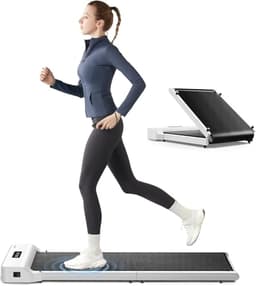
WalkingPad Z1
Smallest storage footprint
The only pad here that folds in half AND stays under 5.5 inches folded, which is the combination a small apartment actually needs.
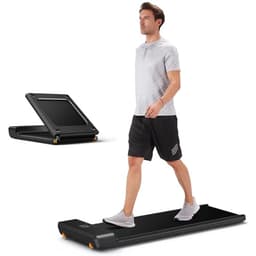
WalkingPad A1 Pro
A published noise figure
One of only two pads on this site whose maker publishes a decibel figure at all, and the only KingSmith model that does.
Price as of October 21, 2026. #ad How we’re funded
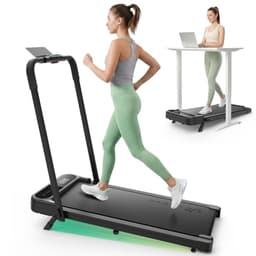
UREVO Strol 2E
Lightest with a handle
The lightest machine here that still has a safety handle, and the only one that goes fast enough to jog on.
Price as of October 21, 2026. #ad How we’re funded
What we have not done
We have not walked on any of these machines, measured any posture, or tested any deck. We are not clinicians and nothing above is medical advice: the one clinical source on this page is quoted verbatim and is about activities and seated posture rather than about any product. The desk arithmetic is computed from published figures in our own registry, and where a maker publishes no deck height we have excluded the machine from the sum rather than estimating one. The full method. If your back hurts, the useful next step is a clinician, not a specification table.
Questions people actually ask
Is a walking pad good or bad for your lower back?
We are not clinicians and we will not answer that about your back. What we can do is name the mechanical problem the published figures reveal, because it is the one most buyers never check: a walking pad raises you 4.1 to 7 inches, so unless your desk can rise by the same amount, you will be working bent for the whole session. That is a desk-height problem rather than a property of the belt, and it is arithmetic you can do before you buy anything.
Why does my back hurt after using a walking pad?
The three candidates we can speak to are all geometric rather than medical. One: the desk is now effectively too low, because you rose by the deck height and it did not, so you are reaching down. Two: you are looking down - at a laptop screen that is also lower relative to you, or at your feet - which loads the neck and upper back. Three: a short or narrow belt makes you watch your feet rather than trust the surface. All three are fixable without buying a different pad, and all three get worse the taller the deck is.
What desk height do I need with a walking pad?
Add the deck height to the standing elbow height you would otherwise use. A rough standing elbow height for a 5 ft 10 in person is about 44 inches; put them on a 4.1 inch deck and the desk needs roughly 48 inches, and on a 7 inch deck roughly 50. That is where the problem bites: the tallest maximum height published by any desk sold for a walking pad is 47 inches, which on the lowest deck we track reaches a walker of about 5 ft 9 in and on the highest about 5 ft 5 in. Nothing in that class reaches a 5 ft 10 in walker on any pad we track.
Which walking pad is best if my back is the constraint?
The WalkingPad Z1, on two published figures. Its 4.1 inch deck is the lowest of the eight pads we track, which gives your desk the most chance of being high enough for you to stand upright at, and its 47.6 x 15.7 inch belt is the longest walking surface on this site, so you are less likely to end up watching your feet. The cost is that 15.7 inches is a narrow belt. If belt width is what you want, the A1 Pro's 16.5 inches is the joint-widest here and KingSmith publishes a 0.5 mph minimum speed for it, the lowest in the category.
Do walking pads have back support or cushioning?
No back support of any kind - there is nothing to lean on, and only one pad we track publishes a handle at all. On cushioning, the honest position is the same one we take on knees: most makers claim some and none quantifies it. No maker on this site publishes a deck deflection figure, a durometer rating or any number you could use to compare two decks on impact, so 'cushioned' here means there is something between the belt and the floor.
What does the public health guidance actually say?
About activity rather than about machines, and we will quote it rather than paraphrase it. MedlinePlus, on acute low back pain and reviewed 27 June 2026, states that bed rest is not recommended, advises staying as active as possible, and says to begin with light aerobic activity, naming walking, riding a stationary bicycle and swimming as examples. It also notes that starting exercises too soon after an injury can make pain worse, and that exercise is important for preventing back pain. None of that is a statement about any product on this page.
Is a seated machine better if sitting is the problem?
If what you need is movement without standing, the seated category removes the desk-height problem entirely, because you do not change height. MedlinePlus's own seated advice is worth reading alongside it: it suggests a small pillow or rolled towel behind the lower back when sitting for long periods, and a stool under the feet so that the knees are higher than the hips - which is a configuration a pedal exerciser occupying your footwell will interfere with rather than help. That tension is worth knowing before you buy one.
Read next
- Are walking pads good or bad for your knees? — the deck version of this question, and the cushioning figure nobody publishes.
- Best standing desks for a walking pad — every published maximum height, and the 47 in ceiling this page runs into.
- Best walking pads for a standing desk — the clearance sums, pad by pad, against a desk you already own.
- What speed should you set a walking pad to? — why the bottom of the published range is the useful end.
- Best walking pads for tall walkers — belt length against a real stride - the figure that stops you looking down.
- How long can you walk on a walking pad? — session length, and the one published duty cycle in the category.
Sources
- WalkingPad Z1 - walkingpad.com product spec table: published in-use dimensions, deck-to-floor height where stated, belt size, speed range, unit weight and capacity (read 2026-07-24)
- WalkingPad A1 Pro - walkingpad.com product spec table: published in-use dimensions, deck-to-floor height where stated, belt size, speed range, unit weight and capacity (read 2026-07-24)
- UREVO Strol 2E - urevo.com product spec table: published in-use dimensions, deck-to-floor height where stated, belt size, speed range, unit weight and capacity (read 2026-07-24)
- MedlinePlus - Low back pain, acute, review date 27 June 2026 (read 2026-10-17): bed rest is not recommended; begin with light aerobic activity, naming walking, riding a stationary bicycle and swimming; starting exercises too soon after an injury can make pain worse; exercise is important for preventing back pain; and for long seated periods, a small pillow or rolled towel behind the lower back and a stool under the feet so that the knees are higher than the hips
- KingSmith / WalkingPad - Z1 product spec table: 'Shock Absorption: EVA & PET' as a materials list with no deflection figure or durometer rating anywhere (read 2026-08-18)