Under-desk bike vs stationary exercise bike
People buy these expecting a compact exercise bike and get something else entirely. The difference is not size. It is that one of them has a saddle and the other does not.
By Stephen V. · Last updated
They are not the same product in two sizes. An exercise bike carries you, so your body weight sits over the cranks and real load is possible. An under-desk pedaler does not— you sit on your office chair, and the frame only ever sees what your legs can push with your back against a chair. That is why it fits under a desk, and why its spec sheet is missing the figures a bike publishes. Best documented here: the DeskCycle.
How this page is funded: the buy links here are Amazon affiliate links, and we earn a commission if you buy through one — at no extra cost to you. It does not change what we rank first, because the commission rate is the same across every machine on this page. Full disclosure.
The saddle is the whole difference
Put the two machines side by side and the obvious difference is size. That is the wrong thing to notice. The difference that produces every other difference is where your body weight goes.
On an exercise bike, the machine carries you. You sit on a saddle mounted to the frame, directly above the cranks. Your mass is part of the drivetrain: you can push down against it, stand on the pedals, lean on the bars. The frame has to be rated for your whole body weight, and the resistance unit has to be able to absorb real power.
On an under-desk pedaler, your chair carries you.The machine sits on the floor in front of you and receives only what your legs can deliver from a seated position with your back against a chair back. You cannot push down hard, because there is nothing holding you in place when you do — the force goes into sliding your chair backwards instead.
That last sentence is the most practically useful one on this page. The failure mode of an under-desk pedal machine is not the machine; it is the chair rolling away from it. Owners discover this in week one, and it is why bracing the chair matters more than resistance settings do. The chair problem, and how to deal with it.
What the missing saddle does to the spec sheet
You can see the consequence of the load path directly in what makers publish, which is the kind of evidence this site is built on.
Maximum user weight largely disappears.An exercise bike publishes one, always, because the frame carries you. Of the six seated machines we track, four publish none at all — the DeskCycle, the YOSUDA, the Sunny mini pedal exerciser and the Cubii Move. The Stamina InMotion E1000 publishes 250 lb, and the Cubii JR1 listing publishes 150 lb, the lowest figure on this site. Every published limit in this category.
Resistance stops being quantified. This is the gap that matters most if you are hoping for a workout. Five of the nine machines here publish a resistance level count — 8, 8, 6, 16, 3 — and exactly one publishes what a level is worth: the DeskCycle, at eight magnetic settings up to 39 lb. A level count tells you how finely a maker divided its range, not how wide the range is or where the top of it sits. Sixteen unlabeled steps can divide a narrower range more finely than eight labeled ones. Worked through properly.
Nobody publishes power.No watts, no metabolic figure, no validated calorie rate, on any of the nine. An exercise bike at the serious end of the market publishes watts precisely because the saddle makes a meaningful power number possible. Here it would not mean anything, so no maker offers one — and we are not going to supply one.
The one number a bike never has to publish
It runs the other way too. There is a specification that decides everything about an under-desk machine and is completely irrelevant to an exercise bike: how tall it is.
An exercise bike stands in open floor. An under-desk pedaler has to live in the gap between your floor and the underside of your desk, with your knees rotating through the top of every pedal stroke inside that gap. Overall height is therefore the make-or-break figure, and the category is bad at publishing it: of the six seated machines here, three publish a height and three do not.
The published figures are 9.5 inches for the Cubii Move, 10 inches for both the DeskCycle and the Cubii JR1, and 11.38 inches for the Stamina InMotion E1000. A crank lifts your knee by the full diameter of the pedal circle at the top of each turn, so the machine height is a floor on the clearance you need, never the whole requirement. How to measure your own clearance before you order.
The four under-desk machines, compared
If you have decided the under-desk category is the right one, here is the field on what it publishes. Ranked on documentation, because that is the only axis anybody has given us numbers for.
| Model | In use (L x W x H) | Unit weight | Max user | Resistance levels |
|---|---|---|---|---|
| DeskCycle Under Desk Bike Pedal Exerciser | 20" L x 24" W x 10" Hmanufacturer spec | Not publishednot published | Not publishednot published | 8manufacturer spec |
| YOSUDA Under Desk Bike | Not publishednot published | Not publishednot published | Not publishednot published | 16retail listing |
| Stamina InMotion E1000 | 24.5" L x 17" W x 11.38" Hmanufacturer spec | 24 lbmanufacturer spec | 250 lbmanufacturer spec | Not publishednot published |
| Sunny Health & Fitness Under Desk Smart Mini Pedal Exerciser (SF-B023005) | Not publishednot published | Not publishednot published | Not publishednot published | Not publishednot published |
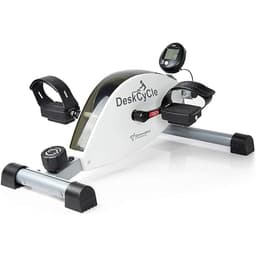
DeskCycle Under Desk Bike Pedal Exerciser
Fitting under a low desk
A 10 inch pedal height is the whole product — it is the seated machine most likely to actually clear a standard 27 inch desk.
Price as of October 4, 2026. #ad How we’re funded
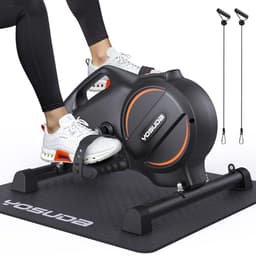
YOSUDA Under Desk Bike
Most resistance steps
Twice the resistance steps of the DeskCycle and app tracking, but the listing does not publish the pedal height that decides whether it fits your desk.
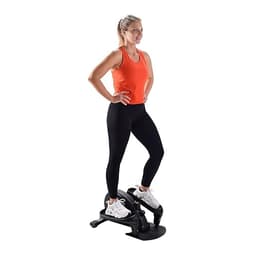
Stamina InMotion E1000
The most complete published spec
The only seated machine here whose maker publishes dimensions, unit weight and a user weight limit together — and the tallest of the three, at 11.38 inches.
Price as of October 4, 2026. #ad How we’re funded
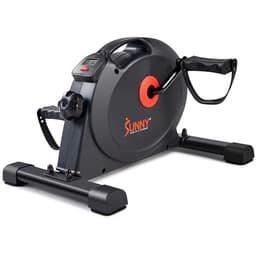
Sunny Health & Fitness Under Desk Smart Mini Pedal Exerciser (SF-B023005)
Trying the idea cheaply
The cheapest way to test whether you will actually use a seated pedaler before spending three figures on one.
DeskCycle— the pick, on documentation. 10 inches tall, 8 magnetic settings, and the only published resistance magnitude in the category at 39 lb. It also publishes a 14-turns-per-stroke flywheel figure, which is the closest thing here to the drivetrain detail an exercise bike would give you. Costs you 24 inches of floor width and publishes no user weight limit.
YOSUDA under-desk bike— 16 resistance levels, double anything else here, plus app tracking. But the listing publishes no height at all, so the one figure that decides whether it fits your desk is missing, and the 16 levels are a granularity claim rather than a magnitude.
Stamina InMotion E1000— an elliptical stroke rather than a pedal circle, and the most complete published spec sheet of any seated machine here: 24.5 x 17 x 11.38 inches, 24 lb, 250 lb capacity, frame rated for standing use. The 11.38 inch height is the tallest here and the most likely to catch a low desk apron. Resistance is described only as “adjustable tension”.
Sunny mini pedal exerciser— the cheap way to find out whether you will use one at all, and it works for arms on a desktop as well as legs on the floor. It publishes no height, no dimensions, no capacity and no resistance count, so there is nothing to check before it arrives.
The case for owning both, briefly
Worth saying, because it is the conclusion a lot of readers should reach: these two products are not competitors.
An exercise bike is a training machine. You change into something, you ride for a defined period, you finish, and it occupies a permanent patch of floor in exchange. An under-desk pedaler is an anti-sitting device. It runs for hours in the background of a working day, at an intensity low enough that you do not notice you are doing it, and it stores under the desk it lives beneath.
If you have the floor space and the budget for one of each, there is no conflict between them. If you have to pick one, pick the one that matches the hours you actually have: the bike for sessions you will schedule, the desk machine for the six hours you are at a keyboard regardless.
And if the hours at the keyboard are the problem but you would rather walk than pedal, that is the other half of this site. Walking pad against a stationary bike covers that fork on footprint and gait.
What this page deliberately does not rank
We do not track upright or recumbent exercise bikes.There are none in our product registry, we have not read their specification pages, and we are not going to name models or publish figures for a category we have not sourced. Every claim above about exercise bikes is a statement about how the machine is built — it has a saddle, you sit on it, the frame carries your weight — not a comparison against any particular model’s numbers.
We have not pedaled any of these.We own none of them. The figures are read from each maker’s own page or the retail listing named at the bottom, with the date we read them, and “not published” means we checked and no figure exists. The full method.
Questions people actually ask
Is an under-desk bike as good as a stationary exercise bike?
For a workout, no, and the reason is the saddle. On an exercise bike you sit on the machine, so your body weight sits over the cranks and can be pushed against; on an under-desk pedaler you sit on your office chair and the machine only ever receives the force your legs can apply while your back is against a chair. For movement during work hours, the under-desk machine is the only one of the two that is usable at all, because nobody types from an exercise bike saddle.
Can you use an under-desk bike instead of a stationary bike?
If the goal is to break up sitting, yes - that is exactly what it is for. If the goal is a training session with a measurable load, no: only one under-desk machine we track publishes what its resistance is actually worth, and none publishes a power output. A real exercise bike publishes resistance and often watts because the saddle makes meaningful load possible.
Is a recumbent bike better than an under-desk pedal exerciser?
They solve different problems. A recumbent bike has a seat and a back, so it supports you and loads the pedals properly, and it occupies a permanent floor footprint. An under-desk pedaler has no seat at all, uses the chair you already own, and disappears under a desk. We do not track recumbent or upright exercise bikes on this site, so we are not going to rank specific models of them.
Why do under-desk bikes not publish a weight limit when exercise bikes do?
Because an exercise bike carries you and an under-desk pedaler does not. Your weight is on your office chair, so the frame never sees it. Four of the six seated machines we track publish no maximum user weight at all, which follows from that - though it still leaves a buyer without a number to check.
Which is quieter?
Neither can be ranked on a published figure, because not one of the nine seated and standing machines on this site publishes a decibel number. What can be said structurally is that a seated machine with magnetic resistance produces no impact at all - your body weight stays on the chair, nothing lands - so it has nothing to transmit into the floor below. That is a mechanical argument rather than a measurement.
What about pedal height - does it matter on an exercise bike?
Not in the same way, because an exercise bike stands in open floor space and you sit on it. On an under-desk machine, overall height is the single specification that decides whether the thing is usable at your desk, and it is the figure the category most often fails to publish. Of the six seated machines we track, only three publish it.
Read next
- Best under-desk bikes and pedal exercisers — the whole category ranked on published pedal height.
- DeskCycle vs YOSUDA under-desk bike — eight quantified settings against sixteen unquantified ones.
- Walking pad vs stationary bike — the same fork, with a walking pad on the other side.
- Pedal exerciser vs walking: is pedaling as good? — the chair argument on this page, applied to walking instead.
- Will an under-desk machine fit under your desk? — the measurement an exercise bike never makes you take.
- Under-desk machines with adjustable resistance — why only one machine here publishes a magnitude rather than a count.
- Under-desk bike vs under-desk elliptical — if you have settled on the category and want the stroke shape decided.
- DeskCycle review — the full spec breakdown of this page's best-documented machine.
- Sunny mini pedal exerciser review — the cheapest machine here, and the complete absence of figures behind it.
- Best under-desk cardio for an office desk you do not own — where no outlet and a fixed desk height change the ranking.
Sources
- DeskCycle Under Desk Bike Pedal Exerciser — VIVO (DeskCycle) product spec table (read 2026-07-24)
- YOSUDA Under Desk Bike — Amazon retail listing (read 2026-07-24)
- Stamina InMotion E1000 — staminaproducts.com product page (read 2026-08-11)
- Sunny Health & Fitness Under Desk Smart Mini Pedal Exerciser (SF-B023005) — Amazon retail listing (read 2026-07-24)